Buy elii.eu ?
We are moving the project
elii.eu .
Are you interested in purchasing the domain
elii.eu ?
domain@kv-gmbh.de · 0541-91531010
Buy elii.eu ?
Are humans apes?
Yes, humans are classified as apes. Apes are a group of primates that includes humans, chimpanzees, gorillas, orangutans, and bonobos. Humans share a common ancestor with these other apes and are considered part of the same biological family, Hominidae. Therefore, humans are considered to be a type of ape. **
Why are there so many intelligent apes in Planet of the Apes?
In the Planet of the Apes franchise, the intelligent apes are a result of a fictional scenario where apes have evolved to possess human-like intelligence and abilities. This is often attributed to a virus that was created in a lab and accidentally spread to the ape population, leading to their rapid evolution. The story explores the consequences of this evolution and the power dynamics between humans and apes. The presence of intelligent apes serves as a central theme in the franchise, allowing for a thought-provoking exploration of societal and ethical issues. **

Similar search terms for Apes
Top-Angebote
Products related to Apes:
-
Uplift Treasures Adjustable Car Accessibility Safety Handle Adjustable Car Accessibility Safety HandleProduct Description Make getting in and out of your vehicle safer and easier with this adjustable car accessibility safety handle. Designed to provide reliable support without tools, it installs quickly and offers a secure grip for seniors,...39,97 $*Shipping: 0,00 $Secure redirect to the provider




-
Which great apes are there?
There are four species of great apes: gorillas, orangutans, chimpanzees, and bonobos. **
-
Does man descend from apes?
No, humans and apes share a common ancestor but do not directly descend from apes. The theory of evolution suggests that humans and apes evolved separately from a common ancestor over millions of years. Both humans and apes have evolved and adapted to their environments in different ways, leading to the distinct species we see today. **
-
Did we descend from apes?
No, humans did not directly descend from apes. Both humans and apes share a common ancestor that lived millions of years ago. Through the process of evolution, humans and apes have evolved separately, each developing unique traits and characteristics. While humans and apes are closely related, they are distinct species with their own evolutionary paths. **
-
Do humans descend from apes?
Humans and apes share a common ancestor, but humans did not directly descend from modern apes. The evolutionary path of humans and apes diverged millions of years ago, leading to the development of distinct species. While humans and apes share similarities due to their common ancestry, they are separate branches on the evolutionary tree. **


Did humans descend from apes?
Humans and apes share a common ancestor, but humans did not directly descend from modern apes. The common ancestor of humans and apes lived around 5 to 7 million years ago, and from there, the evolutionary paths of humans and apes diverged. Humans evolved separately from this common ancestor, developing unique traits and characteristics that distinguish us from modern apes. Therefore, while humans and apes are closely related, humans did not descend from modern apes. **
Can we evolve into apes?
No, humans cannot evolve into apes. Humans and apes share a common ancestor, but they have followed separate evolutionary paths for millions of years. Evolution does not work in a linear fashion where one species transforms into another. Instead, it involves the gradual accumulation of genetic changes over time, leading to the development of new species. Therefore, humans and apes will continue to evolve separately, each following their own unique evolutionary trajectory. **
Top-Angebote
Products related to Apes:
-
Pan Make Brilliant Work: Lessons on Creativity, Innovation and Success by Rod Judkins - Paperback - Self-Help/Business Creativity Guide, Author ofMake Brilliant Work is an inspiring guide by Rod Judkins, drawing on the real-life stories of visionaries from Frida Kahlo to Steve Jobs. This paperback book reveals the methods and mindsets that turn ordinary effort into extraordinary results. Judkins proves that talent alone never guaranteed success — persistence, risk-taking and original thinking did. A motivating read for anyone wanting to unlock their creative potential at work or in life. The book profiles figures who failed at school, were told they lacked talent, or were fired more than once, yet went on to achieve great things. Written by Rod Judkins, published by Pan Macmillan, this book is a reassuring truth: you don't have to be naturally brilliant to produce brilliant work.2,99 £*Shipping: 2,99 £Secure redirect to the provider
-
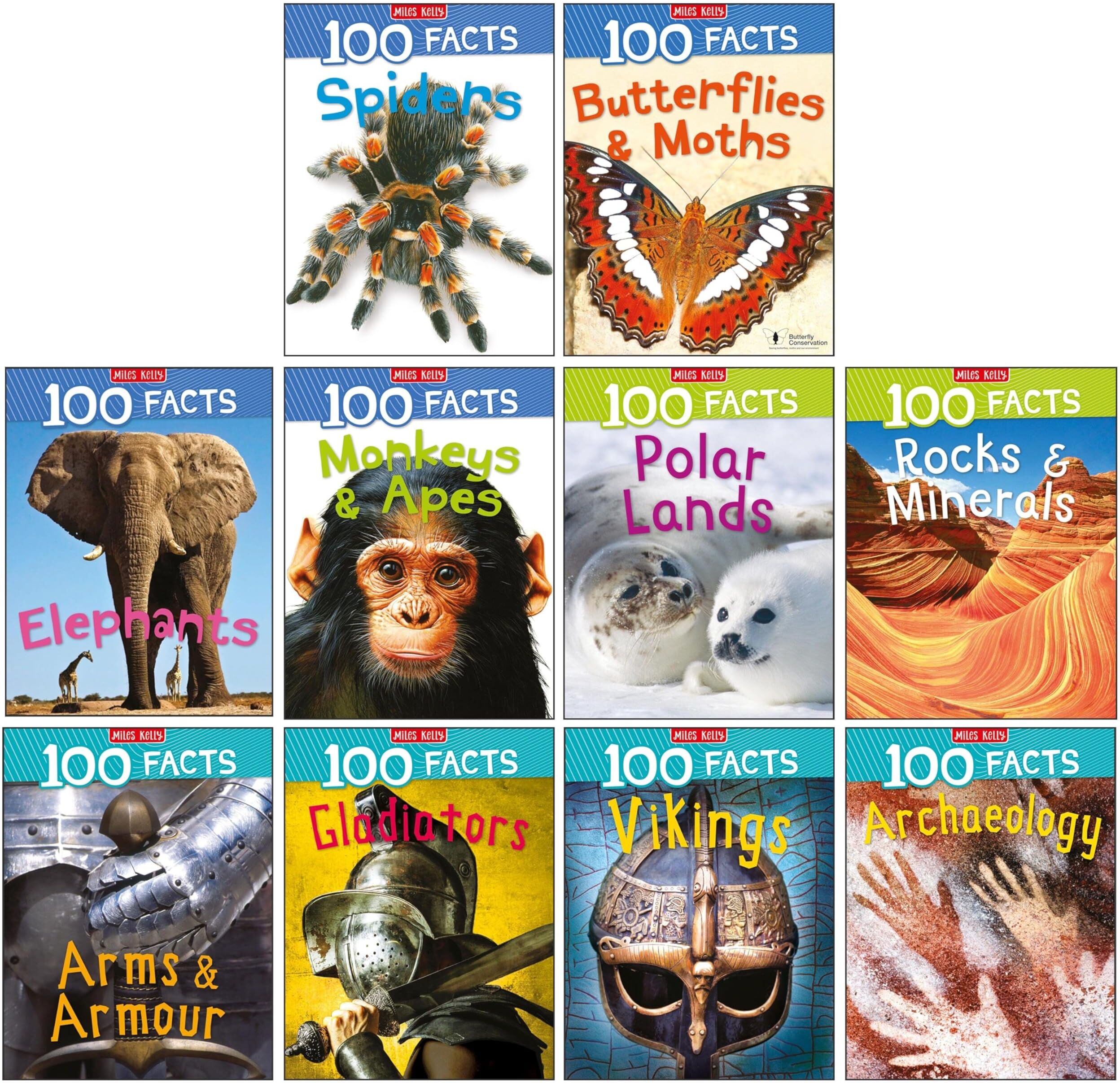
Miles Kelly Publishing 100 Facts Series 10 Books Collection Set (100 Facts: Spiders, Butterflies and Moths, Elephants, Monkeys and Apes, Polar Lands, Rocks and Minerals, ArmTitles in this Set: 1. 100 Facts Spiders 2. 100 Facts Butterflies and Moths 3. 100 Facts Elephants 4. 100 Facts Monkeys and Apes 5. 100 Facts Polar Lands 6. 100 Facts Rocks and Minerals 7. 100 Facts Arms & Armour 8. 100 Facts Gladiators 9. 100 Facts Vikings 10. 100 Facts Archaeology Description: 100 Facts Spiders 100 Facts Spiders is bursting with fascinating images, fun activities and amazing facts all about these eight-legged creatures. Kids learn more easily with bitesized information Photographs and artworks aid children who learn through visual prompts Activities allow children to put what they have learned into practice 100 Facts Spiders includes key topics about many species of arachnids with exciting numbered facts. Each fact is accompanied by beautiful illustrations and photographs, which add visual meaning to the information for kids. This is a fantastic spider book for kids aged 7+ who are intrigued by these creepy crawlies. 100 Facts Butterflies and Moths 100 Facts Butterflies and Moths is a top butterfly book packed with 100 fantastic facts, detailed images and super-fun activities. Close-up photos bring butterflies, moths and caterpillars to life on the page Supports education at key stage 1 and key stage 2 Fun activities and facts throughout to help the information seem less daunting 100 Facts Butterflies and Moths covers key topics in interesting numbered facts. Amazing information alongside clear illustrations and photographs put mind-blowing facts into context for young learners. This butterfly book for children is perfect for school projects, homework and simply discovering more about what's in the garden. 100 Facts Elephants 100 Facts Elephants is bursting with detailed images, activities and exactly 100 amazing facts for children to learn about the biggest land-living creatures in the world. Simple activities help children put difficult ideas into context Looks at different elephant species and where they live Cartoons and fun facts add humour to learning 100 Facts Elephants contains key topics about the extraordinary lives of elephants in straightforward numbered facts. Each fact is accompanied by beautiful illustrations and photographs, which add visual meaning to the information for kids. This elephant book for kids aged 7+ years is ideal for school projects and homework. 100 Facts Monkeys and Apes 100 Facts Monkeys and Apes is bursting with fantastic images, fun activities and awesome primate facts for kids. Kids learn more easily with bitesized information Photographs and artworks aid children who learn through visual prompts Activities allow children to put what they have learned into practice 100 Facts Monkeys and Apes covers key topics about our closest animal relatives in interesting numbered facts. Information is accompanied by amazing illustrations and photographs that put unbelievable facts into context for children. Our monkey books for kids are great for school projects and homework. 100 Facts Polar Lands 100...12,95 £*Shipping: 2,99 £Secure redirect to the provider
-
Uplift Treasures Adjustable Car Accessibility Safety Handle Adjustable Car Accessibility Safety HandleProduct Description Make getting in and out of your vehicle safer and easier with this adjustable car accessibility safety handle. Designed to provide reliable support without tools, it installs quickly and offers a secure grip for seniors,...39,97 $*Shipping: 0,00 $Secure redirect to the provider
-
Are humans apes?
Yes, humans are classified as apes. Apes are a group of primates that includes humans, chimpanzees, gorillas, orangutans, and bonobos. Humans share a common ancestor with these other apes and are considered part of the same biological family, Hominidae. Therefore, humans are considered to be a type of ape. **
-
Why are there so many intelligent apes in Planet of the Apes?
In the Planet of the Apes franchise, the intelligent apes are a result of a fictional scenario where apes have evolved to possess human-like intelligence and abilities. This is often attributed to a virus that was created in a lab and accidentally spread to the ape population, leading to their rapid evolution. The story explores the consequences of this evolution and the power dynamics between humans and apes. The presence of intelligent apes serves as a central theme in the franchise, allowing for a thought-provoking exploration of societal and ethical issues. **
-
Which great apes are there?
There are four species of great apes: gorillas, orangutans, chimpanzees, and bonobos. **
-
Does man descend from apes?
No, humans and apes share a common ancestor but do not directly descend from apes. The theory of evolution suggests that humans and apes evolved separately from a common ancestor over millions of years. Both humans and apes have evolved and adapted to their environments in different ways, leading to the distinct species we see today. **
Similar search terms for Apes
-
Rilastil Progression HD Rich Cream 40 mlHealth and Beauty Creams Rilastil Progression HD Rich Cream 40 ml Anti-wrinkle and nourishing cream, effective filler to counteract the formation of deep wrinkles. For dry and very dry skin. Thanks to its specific and innovative cosmetic ingredients, capable of responding to the needs of tired, dehydrated, and emollient-poor skin, Rilastil Lady Progression exerts its nourishing, anti-wrinkle, and moisturizing action day after day, providing protection and energy to the skin. How to Use: Apply the cream in small touches, then gently massage it all over your face. It leaves your skin velvety soft, perfectly hydrated, and radiant all day long.32,05 £*Shipping: 3,99 £Secure redirect to the provider
-
Rilastil Progression (+) Anti-Wrinkle Serum 30 mlHealth and Beauty Serums Rilastil Progression (+) Anti-Wrinkle Serum 30 ml What is Rilastil Progression (+) Anti-Wrinkle Serum 30 ml? Rilastil Progression (+) Anti-Wrinkle Serum 30 ml is an advanced serum designed to effectively combat wrinkles and fine lines. Formulated with a combination of high-quality active ingredients, this serum provides intensive action to help smooth, plump, and revitalize the skin, noticeably improving its appearance and texture. Benefits Wrinkle Reduction : Its advanced formula acts on wrinkles and expression lines, reducing their appearance. Deep hydration : Provides intense hydration that improves skin elasticity and firmness. Rejuvenation : Helps revitalize the skin, leaving it softer, brighter and more youthful. Improved texture : Improves the texture of the skin, making it more even and soft to the touch. Antioxidant protection : Protects the skin from damage caused by free radicals, preventing premature aging. Dermatological compatibility : Suitable for all skin types, including sensitive skin. Who is it for? Rilastil Progression (+) Anti-Wrinkle Serum 30 ml is especially recommended for: People concerned about visible wrinkles and expression lines on their skin. Individuals seeking an effective serum to improve skin firmness and elasticity. Those who wish to rejuvenate their skin and reduce the visible signs of aging. All skin types, including mature skin, thanks to its gentle, dermatologically tested formulation. How do I apply it? To get the best results with Rilastil Progression (+) Anti-Wrinkle Serum 30 ml , follow these simple steps: Cleansing : Cleanse your face with a gentle cleanser and dry with a clean towel. Application : Apply a small amount of serum to the skin of the face and neck. Massage : Gently massage in upward circular motions until the serum is completely absorbed. Frequency : Use daily, morning and/or night, as part of your facial care routine. Product use Rilastil Progression (+) Anti-Wrinkle Serum 30 ml is ideal for incorporating into your daily skincare routine. Its advanced formula allows the active ingredients to penetrate deeply into the skin, providing visible results in the reduction of wrinkles and fine lines. Enjoy smoother, firmer, and rejuvenated skin with continued use of this anti-wrinkle serum. Buy Rilastil Progression (+) Anti-Wrinkle Serum 30 ml Get Rilastil Progression (+) Anti-Wrinkle Serum 30 ml and discover the power of visibly younger and revitalized skin. On our e-commerce site, we offer this serum at the best price and with fast shipping so you can start enjoying its anti-wrinkle benefits as soon as possible. Rilastil Progression (+) Anti-Wrinkle Serum 30 ml is the perfect choice for those who want to effectively combat wrinkles and rejuvenate their skin. Don't wait any longer to show off smoother, more radiant skin!37,72 £*Shipping: 3,99 £Secure redirect to the provider
-
Did we descend from apes?
No, humans did not directly descend from apes. Both humans and apes share a common ancestor that lived millions of years ago. Through the process of evolution, humans and apes have evolved separately, each developing unique traits and characteristics. While humans and apes are closely related, they are distinct species with their own evolutionary paths. **
-
Do humans descend from apes?
Humans and apes share a common ancestor, but humans did not directly descend from modern apes. The evolutionary path of humans and apes diverged millions of years ago, leading to the development of distinct species. While humans and apes share similarities due to their common ancestry, they are separate branches on the evolutionary tree. **
-
Did humans descend from apes?
Humans and apes share a common ancestor, but humans did not directly descend from modern apes. The common ancestor of humans and apes lived around 5 to 7 million years ago, and from there, the evolutionary paths of humans and apes diverged. Humans evolved separately from this common ancestor, developing unique traits and characteristics that distinguish us from modern apes. Therefore, while humans and apes are closely related, humans did not descend from modern apes. **
-
Can we evolve into apes?
No, humans cannot evolve into apes. Humans and apes share a common ancestor, but they have followed separate evolutionary paths for millions of years. Evolution does not work in a linear fashion where one species transforms into another. Instead, it involves the gradual accumulation of genetic changes over time, leading to the development of new species. Therefore, humans and apes will continue to evolve separately, each following their own unique evolutionary trajectory. **
* All prices are inclusive of VAT and, if applicable, plus shipping costs. The offer information is based on the details provided by the respective shop and is updated through automated processes. Real-time updates do not occur, so deviations can occur in individual cases. ** Note: Parts of this content were created by AI.